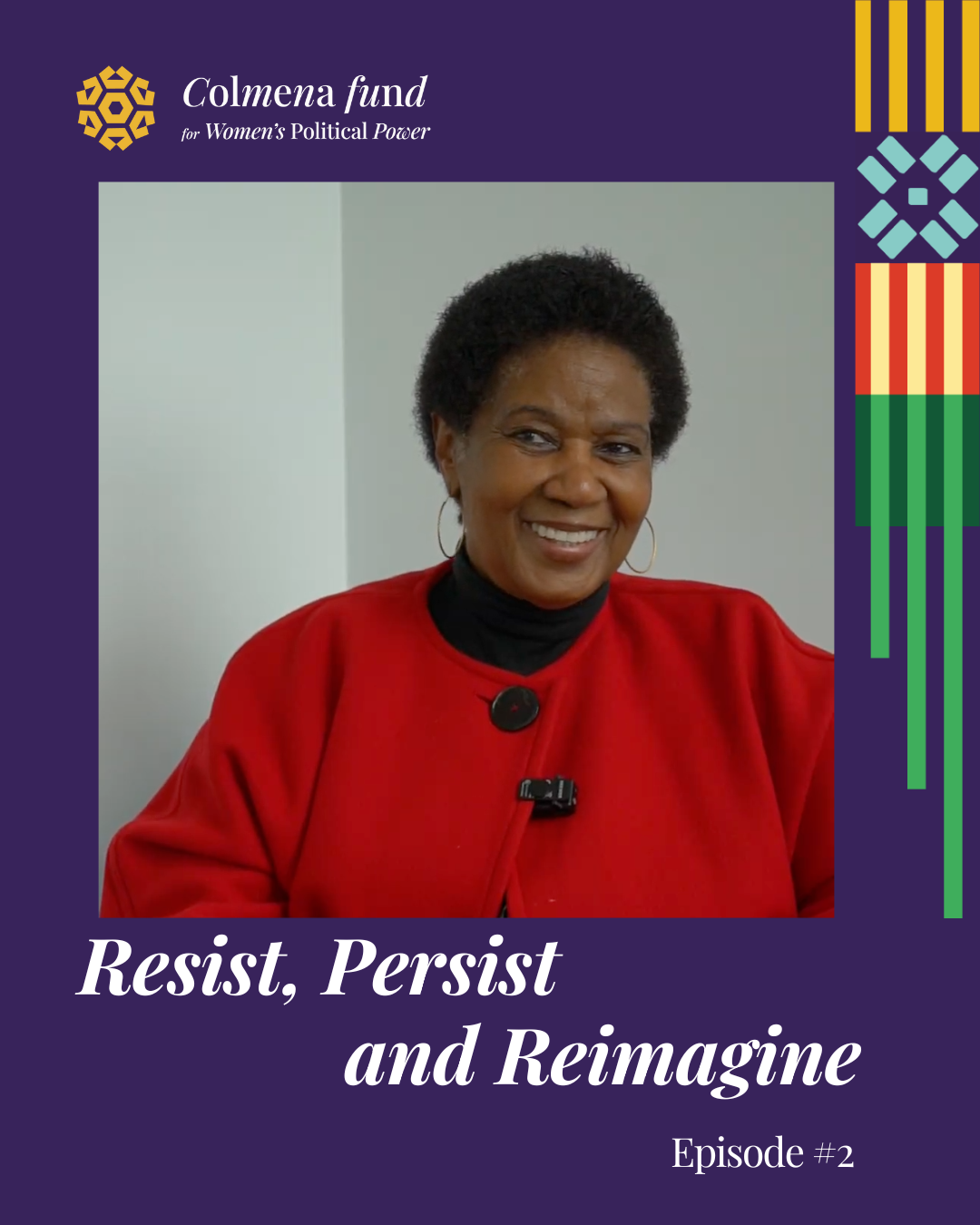
During the 69th session of the UN Commission on the Status of Women (CSW 69), we had the honor of speaking with Phumzile Mlambo-Ngcuka—a globally respected leader, former Executive Director of UN Women, and member of the Colmena Fund Steering Committee.
In our conversation, Mlambo-Ngcuka offered profound reflections on her political journey, the global state of women’s rights, and the enduring challenges democracy is facing. Her activism began in her youth, under South Africa’s Apartheid regime. As a student, she understood the urgency of political mobilization and soon became actively engaged in organizing her peers—an experience that, she recalls, “really consumed me at the time.”
Once she completed her studies, the decision to remain in political work felt inevitable. From the start, her commitment to social change was rooted in fighting systemic injustice. Looking back from 2025 to the 1970s, she maintains a clear stance: “We’re not done… the job is not fully done”.
For Mlambo-Ngcuka, the obstacles women face in South Africa are not exceptional but part of a global pattern. “The challenges of the women in South Africa are similar to the challenges of women anywhere else in the world,” she says. Gender-based violence continues to be a critical issue, both in private spheres and increasingly in public spaces. In terms of political representation, while the public sector in South Africa has made some progress, women remain underrepresented in senior roles—particularly in the private sector. Even in public institutions, she notes, it’s necessary to push not only for representation but for quality leadership that can truly deliver.
“Sometimes also in the public sector, you have to continuously fight for the quality of the women who represent you. To push that they choose women who can do the job”.
Economic inequality persists and it deeply affects women. “Poverty still wears a woman’s face in South Africa,” she states, and the digital divide, exacerbated by rapid technological advancement, poses additional barriers, especially for girls and women. These challenges, she points out, are closely aligned with the global priorities outlined by UN Women for the Beijing +30 platform.
She emphasizes the need for women’s active participation in politics—not only to occupy these spaces, but to influence policy and decision-making. “It’s important for women to be involved in the politics of their countries so that they can be insiders.” But political presence, she insists, must be matched by preparation and competence. “Showing up is absolutely important, but also always being prepared so that by showing up the women are able to deliver on the tasks that are at hand.” This, she says, is key to building trust with constituents and ensuring that women in public office are not unfairly blamed for failures in service delivery.
In the current global context, Mlambo-Ngcuka sees philanthropy as playing an increasingly important role. “Philanthropy is solidarity… the solidarity expressed by those who have resources to support the other people in their important endeavors of making their lives better.” At a time when official development assistance (ODA) is declining, this kind of support becomes even more vital.
She is critical, however, of the long-term effects of ODA. In her view, it has often undermined national capacity and encouraged dependence among inefficient or corrupt governments.
She questions the sustainability of health systems in the Global South that rely heavily on foreign aid. Although the loss of ODA may be painful in the short term, she believes it creates an opening to build greater self-reliance—with the help of philanthropy as transitional support. “This is, I think, a time for us to end ODA. But we must have fair terms of trade; the cost of capital to developing countries must not be as expensive as it is today.”
Mlambo-Ngcuka also highlights the current political climate as a source of serious concern. Around the world, authoritarian leaders are gaining ground—leaders who are openly sexist, racist, and dismissive of international law. “In this era, we have strong men who are dictatorial, who are cruel, who are sexist, who are racist… all of those things impact women and women’s rights.” These dynamics, she warns, have direct consequences for women’s safety, freedom, and political participation.
She calls on women to take a clear stance—especially those not constrained by institutional affiliations and not bound by diplomatic considerations. “Women must make their voices known, and that is also where there is space to resist. They should show their disagreement by using methods that are not just passive; they should actively resist all of these dictatorial tendencies that erode the sovereignty of countries—and sovereignty is important for women too.”
Beyond explicitly gendered issues, she urges women to engage in all areas of public life. “Those are the issues that chip away at the different opportunities that could be important for advancing gender equality,” she notes. Every political and economic issue—from trade to public services—affects the conditions under which women can thrive.
She closes by offering a vision of democracy that is grounded in collective responsibility. For her, democracy means ensuring that everyone has access to education, health, economic opportunity, and the freedom to live a life of dignity. It also requires that leaders govern in consultation with citizens and remain accountable—especially in difficult times. “Democracy is a process of to and fro,” she says. “You inform your government, you give your response, you support your government when they struggle… but you can only do that when you know what they are doing, why they are doing it, and if this is what you elected them to do.”